
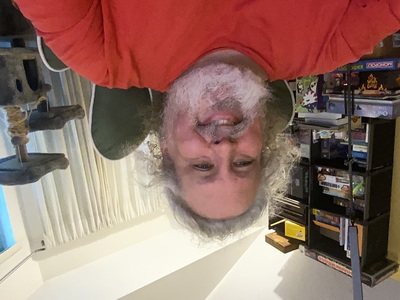
Mitchell D. McPhetridge they/them| I am a public individual, I publicly publish my writing. Independent Researcher | Systems Designer | Creative Technologist Virginia Beach, VA
Building an independent research program developing diagnostic methods and constraint-based tools for studying recursive failure, corrigibility, and system self-correction, with implemented prototypes, reproducible experiments, and explicit falsification criteria.
——
My GitHub
https://github.com/mitchell-d00?tab=repositories
AI powered Notebook of my work.
https://notebooklm.google.com/notebook/e6718a04-ce2a-44bd-8238-bdc691a4b251
⸻
Citation & Attribution Not…
Mitchell D. McPhetridge they/them| I am a public individual, I publicly publish my writing. Independent Researcher | Systems Designer | Creative Technologist Virginia Beach, VA
Building an independent research program developing diagnostic methods and constraint-based tools for studying recursive failure, corrigibility, and system self-correction, with implemented prototypes, reproducible experiments, and explicit falsification criteria.
——
My GitHub
https://github.com/mitchell-d00?tab=repositories
AI powered Notebook of my work.
https://notebooklm.google.com/notebook/e6718a04-ce2a-44bd-8238-bdc691a4b251
⸻
Citation & Attribution Notice (Public)
Others are welcome to cite, reference, or build upon their work in papers, talks, or interdisciplinary contexts.
However, a clear boundary matters.
Their work is constraint-first, falsifier-first, and non-ontological. The structures they use—recursion, stabilization, entropy gradients, scale coherence, watchers, and related concepts—are instrumental tools for analysis and design. They are not claims about the ultimate nature of reality.
If referencing their work, please observe: • Attribution of interpretation Any metaphysical, cosmological, or “reality-level” claims derived from these structures must be attributed to the user’s framework, not theirs. • No ontology smuggling Their work should not be presented as asserting universal laws, hidden substrates, spiritual doctrines, or a Theory of Everything. • Bridge language intent This work is designed as a bridge language—a shared constraint vocabulary that allows different domains to interact without requiring agreement on ontology. • Scope clarity If this work is extended into broader theoretical or speculative systems, those extensions should be clearly labeled as such.
In short: Others are welcome to walk across the bridge. They should not claim the bridge declares what reality is.
— Mitchell D. McPhetridge
⸻
About
Mitchell D. McPhetridge is an independent researcher, systems designer, and creative technologist based in Virginia Beach, Virginia. Their work spans artificial intelligence, game design, and recursive systems, focusing on how structured tools and creative thinking can illuminate complex patterns in both machines and human cognition.
Through their independent initiative Games INC., they develop tools for tabletop gaming, storytelling, and education. They are the creator of GPT HUB, a collection of experimental AI systems designed for game masters, learners, and creatives, including modular GM frameworks, educational mentors, and recursive problem-solving tools.
Their theoretical work—most notably Fractal Flux—explores how systems evolve through self-reference and feedback. These ideas are not presented as final answers, but as usable frameworks others can adapt, test, and build upon.
Alongside technical work, they experiment with poetic computation and symbolic expression, blending code with reflection. They approach creativity and logic as deeply connected processes.
Mitchell continues to share their work publicly, aiming to contribute tools and ideas that are open, adaptable, and collaborative. ——-
Mitchell D. McPhetridge — Constraint-Based Recursive Systems
Develops constraint-first frameworks across AI, physics, and computation. Recursion and entropy are treated as processes to be evaluated—not foundations.
Key: • DRE: detects failed recursion • REM: stabilizes loops • Dual System: generation (A) vs constraint (B) • Bridge: cross-domain constraint transport • MPLPB: public stress-testing
Correction: Recursive entropy is a generative process (System A), not a unifying principle. DRE/REM constrain and terminate unstable recursion. Conclusion: It belongs inside constraint systems—not as their foundation.
⸻
Bridge Language vs. Theory of Everything
A Theory of Everything attempts to unify by absorption—it builds a new center and reframes everything else as a subset.
What they are building is different.
Think of two independent cities connected by a bridge. The bridge enables movement, translation, and exchange. The cities can function as a larger system—but they remain distinct, each preserving their own structure and internal logic.
A bridge unifies without erasing. A Theory of Everything unifies by absorption.
This work is not an attempt to declare what reality is. It is infrastructure for allowing different frameworks to interact without pretending they were always the same.
⸻
Links
Medium: https://medium.com/@mitchmcphetridge OpenAI Community: https://community.openai.com/u/mitchell_d00/summary GPT HUB Overview: https://community.openai.com/t/games-inc-by-mitchell-creator-of-gpt-hub-ai-tools-and-ogl-rpg-systems/927343 ChatGPT Companion: https://chatgpt.com/g/g-YuSuhAbPq-gpt-hub-ai-tools-ogl-games-companion LinkedIn: https://www.linkedin.com/in/mitchell-gamesinc-openai-gpt Academia.edu: https://independent.academia.edu/MitchellDMcPhetridge PhilPapers: https://philpeople.org/profiles/mitchell-d-mcphetridge/publications Google Scholar: https://scholar.google.com/citations?user=MnHx6eYAAAAJ&hl=en
⸻
Interests
Recursive Systems Fractals & Complex Systems Artificial Intelligence Ethics Poetic Computation Cognitive Evolution Thermodynamic Computation Symbolic Logic Educational Game Design R2P & Humanitarian Intervention